
PTFE (Polytetrafluoroethylene) powder is a highly valued industrial material known for its exceptional chemical resistance, low friction, and high temperature stability. However, its unique physical properties—such as fine particle size, low bulk density, and tendency to agglomerate—pose significant challenges for conventional material handling methods. Pneumatic conveying offers a clean, efficient, and automated solution specifically tailored for PTFE powder transport. As a leading PTFE powder pneumatic conveying manufacturer, Shandong Haide Powder Engineering Co., Ltd. (Haide Powder) delivers turnkey systems that ensure minimal product degradation, dust-free operation, and precise flow control. This article details the core aspects of PTFE powder pneumatic conveying, covering engineering design, system components, and selection criteria for industrial applications.
Traditional mechanical conveyors, such as screw conveyors or belt conveyors, often struggle with PTFE powder due to its fine, lightweight nature. These powders can easily become airborne, leading to material loss, dust hazards, and equipment wear. Pneumatic conveying, on the other hand, uses a stream of air or inert gas to transport the powder through enclosed pipelines. This method offers several advantages: it eliminates dust emissions, reduces contamination risks, allows for flexible routing, and simplifies maintenance. For facilities handling PTFE powder, a well-designed pneumatic conveying system ensures consistent throughput while preserving the powder's critical properties. As a trusted PTFE powder conveying engineering design provider, Haide Powder customizes every system to match the specific particle size distribution, moisture content, and flow characteristics of the client's material.

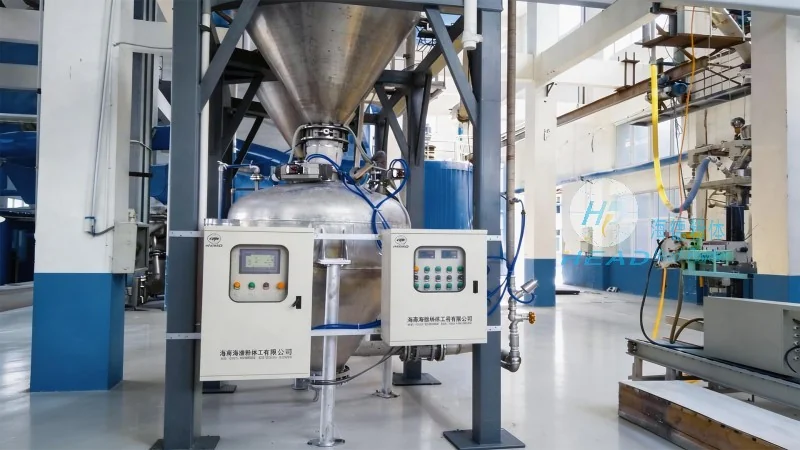
A complete PTFE powder conveying system typically includes a feeding device (such as a rotary airlock or venturi eductor), a conveying pipeline, a separation unit (cyclone or filter receiver), and a control system. The feeding device introduces the powder into the air stream at a controlled rate. The pipeline, often constructed from stainless steel or abrasion-resistant materials, carries the mixture to the destination. At the discharge point, the solids are separated from the conveying air using a cyclone separator or a baghouse filter, ensuring that the powder is collected cleanly while the air is exhausted or recirculated. The control system monitors pressure, flow rate, and material level to maintain stable operation. Haide Powder's engineering team integrates these components into a cohesive solution that meets the exact requirements of each application. Whether for dilute phase or dense phase conveying, the system is optimized to minimize energy consumption and prevent pipe blockages—a common issue with fine PTFE powders. For more information or to discuss your project, contact Manager Zhang at 15662777102.

PTFE powder conveying engineering design is not a one-size-fits-all process. The design must account for several critical parameters: particle size (typically 1–500 microns), bulk density (often 0.3–0.6 g/cm³), angle of repose, abrasiveness, and potential for electrostatic charge buildup. A PTFE powder pneumatic conveying manufacturer like Haide Powder performs material testing and computational fluid dynamics (CFD) simulations to determine the optimal conveying velocity, air-to-material ratio, and pipeline diameter. For example, fine PTFE powders may require lower velocities to avoid particle attrition, while coarser grades might tolerate higher speeds. The system layout must also consider the distance, elevation changes, and number of bends, as these factors affect pressure drop and wear. Haide Powder's engineers have extensive experience in designing systems for chemical, pharmaceutical, and plastics processing industries, ensuring reliable performance even under demanding conditions. They provide detailed documentation, including piping and instrumentation diagrams (P&IDs), layout drawings, and operational manuals.
PTFE powder is used in a wide range of applications, including as a lubricant additive, a filler for plastics and rubber, a coating raw material, and a component in sealants and gaskets. Industries such as automotive, aerospace, electronics, and chemical processing rely on efficient and clean material handling. A PTFE powder conveying system from Haide Powder can be integrated into existing production lines for dosing, mixing, or packaging. For instance, in the production of PTFE-based lubricants, the system delivers precise amounts of powder to a blending vessel, eliminating manual handling and reducing waste. In the manufacture of high-performance seals, the conveying system ensures a consistent feed to compression molding or extrusion machines. The company's solutions are also used in centralized distribution networks where multiple receiving points require simultaneous or sequential feeding. As a full-service PTFE powder conveying engineering design and system provider, Haide Powder supports clients from initial consultation through commissioning and after-sales service.

When evaluating a PTFE powder pneumatic conveying system, several factors should be considered: system capacity (tons per hour), conveying distance, type of conveying (dilute phase vs. dense phase), material compatibility with pipeline materials, and the need for explosion protection. PTFE powder is generally non-explosive, but fine dust can pose a risk in certain concentrations. Haide Powder incorporates safety features such as grounding, pressure relief vents, and inert gas purging as needed. The company also offers options for automated control, remote monitoring, and data logging to improve operational efficiency. With years of experience as a leading PTFE powder pneumatic conveying manufacturer, Haide Powder has delivered hundreds of systems worldwide, earning a reputation for reliability and innovation. For a free consultation, call Manager Zhang at 15662777102. Located in China Shandong, the company serves domestic and international clients, providing cost-effective solutions that meet the highest standards of quality and safety.
Shandong Haide Powder Engineering Co., Ltd. (Haide Powder) is a professional engineering firm specializing in powder and bulk solids handling. The company's core competencies include the design, fabrication, installation, and commissioning of PTFE powder conveying systems. With a team of experienced engineers and technicians, Haide Powder offers end-to-end project management, from feasibility studies to final acceptance. The company's manufacturing facility is equipped with advanced metalworking and testing equipment, ensuring that every component meets stringent quality standards. Moreover, Haide Powder provides comprehensive after-sales support, including spare parts, maintenance training, and troubleshooting. By choosing Haide Powder as your PTFE powder conveying engineering design partner, you gain access to cutting-edge technology, customized solutions, and a dedicated team committed to your success. Contact Manager Zhang today at 15662777102 to start your project.
Shandong Headpowder Engineering Co., Ltd.
156-6277-7102(Manager Zhang)
0531-83386006
Jinan City, Shandong Province, China 
telephone
WeChatconsult
top